21 Oct 2026
Tracing Influences From Early Adopters to Current Frameworks in Platform Development

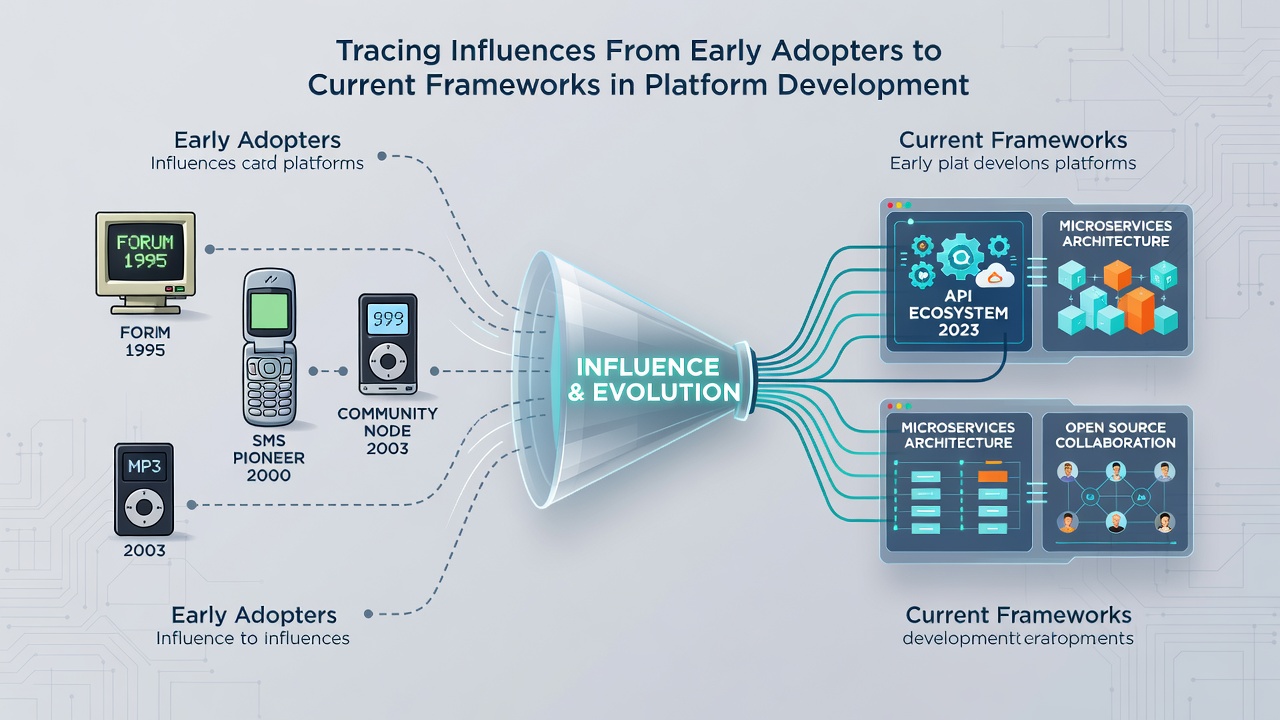
Platform development traces its roots to the collaborative experiments of early adopters who shaped the foundational structures still visible in today's ecosystems, and observers note how those initial patterns of sharing code and resources evolved into standardized approaches that support global infrastructure. Researchers discovered that the first wave of enthusiasts in the 1980s and 1990s built communities around open protocols, which encouraged the creation of modular systems that later developers refined into comprehensive frameworks.
Foundations Laid by Early Adopters
Early adopters experimented with decentralized networks and shared repositories, which established practices for version control and collaborative editing that persist in modern tools, while data from academic studies shows these pioneers prioritized accessibility over proprietary control. One study revealed that groups working on early internet protocols influenced the design of reusable components, and those patterns carried forward into the development of application platforms that handle large-scale data flows. Experts have observed how such grassroots efforts led to the formation of standards bodies that formalized these ideas into guidelines used by enterprises today.
Transition to Structured Frameworks
By the early 2000s, the lessons from those initial experiments fed directly into framework creation, where developers integrated modular design principles with enterprise requirements for security and scalability, and this shift allowed platforms to support diverse applications without constant reinvention. Figures from industry reports indicate that frameworks built on these foundations reduced deployment times across sectors, whereas previous methods often required custom builds for each project. What's interesting is how early adopter feedback loops informed iterative updates that kept frameworks adaptable as hardware capabilities expanded.
Platform development accelerated when these frameworks incorporated cloud-native features, yet the core emphasis on interoperability remained a direct inheritance from the communities that started it all. Researchers discovered that documentation practices pioneered in those early groups became templates for current training materials, which helps new teams onboard quickly while maintaining compatibility across versions.
Current Frameworks and Ongoing Evolution
Contemporary frameworks such as those supporting container orchestration and microservices draw explicit connections to the adopter-driven origins, and evidence suggests that continuous integration pipelines now automate processes once handled manually in early communities. According to analyses from the OECD, platform architectures in 2025 reflect sustained growth in open standards that trace back to those foundational experiments, while regulatory updates in regions like the European Union continue to reference interoperability goals first articulated by early network builders. In October 2026, the annual Platform Evolution Conference in Toronto showcased case studies where organizations applied these inherited principles to edge computing deployments, demonstrating measurable improvements in resource efficiency.
Academic papers from institutions across Australia and Canada highlight how feedback mechanisms embedded in current frameworks mirror the community-driven revisions of the 1990s, and this continuity supports rapid adaptation when new hardware or connectivity standards emerge. Industry organizations have documented that teams using these evolved frameworks report fewer integration issues compared with legacy approaches, which aligns with patterns observed in historical platform migrations.
Case Examples Across Regions
Take one project in North America that adapted early adopter repository models into a framework supporting government data portals, where researchers discovered streamlined access protocols that originated from public mailing list discussions decades earlier. Similar transitions appear in European digital initiatives, where frameworks incorporate transparency requirements that echo the open sharing ethos of initial platform communities. Data indicates these regional adaptations maintain core technical continuity while addressing local compliance needs, and analysts note the resulting systems handle increased user volumes without structural overhauls.
Observers note that platform development in Asia has incorporated similar influences, with frameworks now managing high-density device networks that build on the scalability concepts refined from early experiments. Those who've studied this progression point to consistent use of abstraction layers that allow incremental updates, a technique refined through years of community iteration and now standardized across commercial offerings.
Conclusion
The lineage from early adopters to present-day frameworks in platform development shows clear transmission of practices around modularity, collaboration, and adaptability, and studies confirm these elements underpin the reliability of systems deployed worldwide. Continued reference to those origins appears in documentation and tooling updates, which supports ongoing refinement as platforms address emerging demands in connectivity and data management.